
Cholelithiasis
Cholelithiasis refers to the presence of gallstones of varying size within the gallbladder.
It is a highly prevalent condition, affecting women (predominantly) and men worldwide.
It causes symptoms such as:
• Pain in the upper abdomen (particularly on the right side), presenting as biliary colic following the consumption of fatty meals.
• Fever when the gallbladder becomes inflamed (cholecystitis, empyema of the gallbladder), typically due to obstruction of the cystic duct.
• Fever with chills and jaundice when a gallstone obstructs the common bile duct. This is a potentially dangerous complication, although it can now often be managed non-surgically.
• Acute pancreatitis when irritation of the pancreas occurs due to a gallstone migrating toward the exit of the common bile duct into the duodenum. This is a very serious complication requiring hospital admission and treatment.
Severe pancreatitis occurs in approximately 3% of all cases and is associated with significant morbidity and mortality.
When cholelithiasis is diagnosed, even in asymptomatic patients, the patient MUST undergo surgical treatment. A cholecystectomy must be performed.
How?
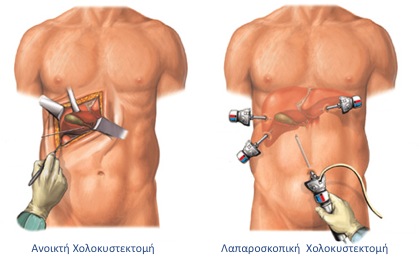
Since 1989, the operation has been performed using the laparoscopic approach—the established LAPAROSCOPIC CHOLECYSTECTOMY.
The procedure is carried out under general anesthesia and employs highly advanced, state-of-the-art technological equipment and instruments.
Only three or four small skin incisions (3–10 mm) are required, through which the laparoscopic removal of the gallbladder is performed with the highest degree of SAFETY.
This technique requires specialized training of both the surgeon and the surgical team.
The advantages of this method include minimal physiological stress on the patient, early mobilization, and rapid postoperative recovery.
The patient is discharged on the same day or the following day, able to resume normal dietary intake.
If the patient wishes, they may return to work promptly (3–5 days) and resume usual daily activities.