
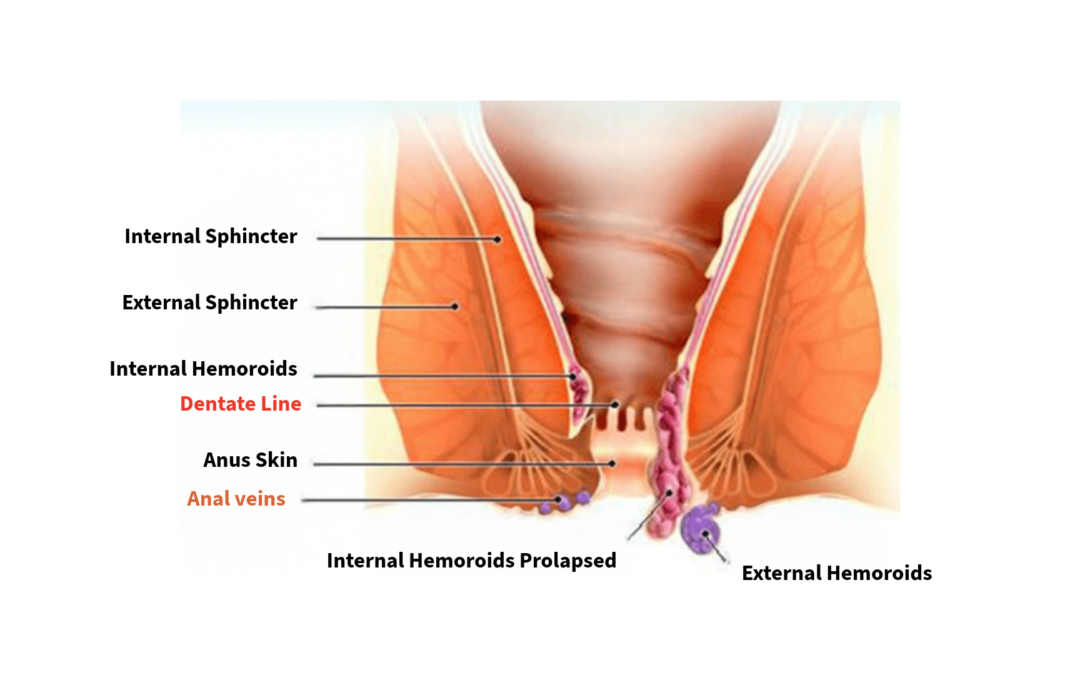
Haemorrhoids are a very common benign condition of the anorectal region.
Symptoms:
• Pruritus
• Mucous discharge from the anus, or more commonly, the appearance of blood on toilet paper during defaecation (and bleeding during bowel movements, particularly in chronic haemorrhoidal disease)
• Small swellings or nodules at the anal verge, or painful perianal lumps
Constipation is frequently a preceding factor.
Diagnosis is established by simple digital rectal examination.
However, other anorectal conditions must be excluded, requiring mandatory colonoscopic assessment of the large bowel.
Management
Patients diagnosed with haemorrhoids should initially undergo conservative treatment:
• Optimised diet
• Avoidance of constipation through regulated bowel habits
If conservative measures fail, surgical intervention is required.
Timely surgery prevents progression of haemorrhoidal disease, formation of fissures or fistulae, and importantly, the development of anaemia due to recurrent bleeding.
A newer surgical method is the LOGO haemorrhoidectomy technique.
Unlike open haemorrhoidectomy, the haemorrhoidal cushions themselves are not excised.
Instead, a circumferential excision of tissue is performed low in the rectum to interrupt the blood supply to the haemorrhoidal plexus, using a specialised circular stapling device.
Following the procedure, the haemorrhoidal cushions become inactive and gradually shrink.
Shrinkage may be further accelerated with adjunctive laser therapy.
The operation may be performed under regional anaesthesia (spinal or epidural), though general anaesthesia is preferred.
Postoperative course
Pain is minimal to absent, and when present, is typically managed with simple analgesics such as paracetamol.
Sitz baths are not required, and patients usually return to daily activities much more rapidly compared to the open Milligan–Morgan procedure.
The technique requires specific surgical training.
The surgeon performing this technique received direct training from the Italian surgeon LOGO, who first introduced the method.